

This article first appeared in the Marketing Fix Substack. Subscribe here for a bi-weekly (Fridays) delivery of hands-on marketing tactics based on 12y of growth roles in 50+ tech companies in the EU, UK, and US.
I put off starting this article on marketing AI armageddon for over a week.
The mental overload from infinite AI use cases is real.
To the point that, finally, to give this sense of chaos a tangible image, my brain time-travelled 2 million years back to Pleistocene.
The image that arose in my head at 9pm on a Wednesday evening was of a woolly mammoth.
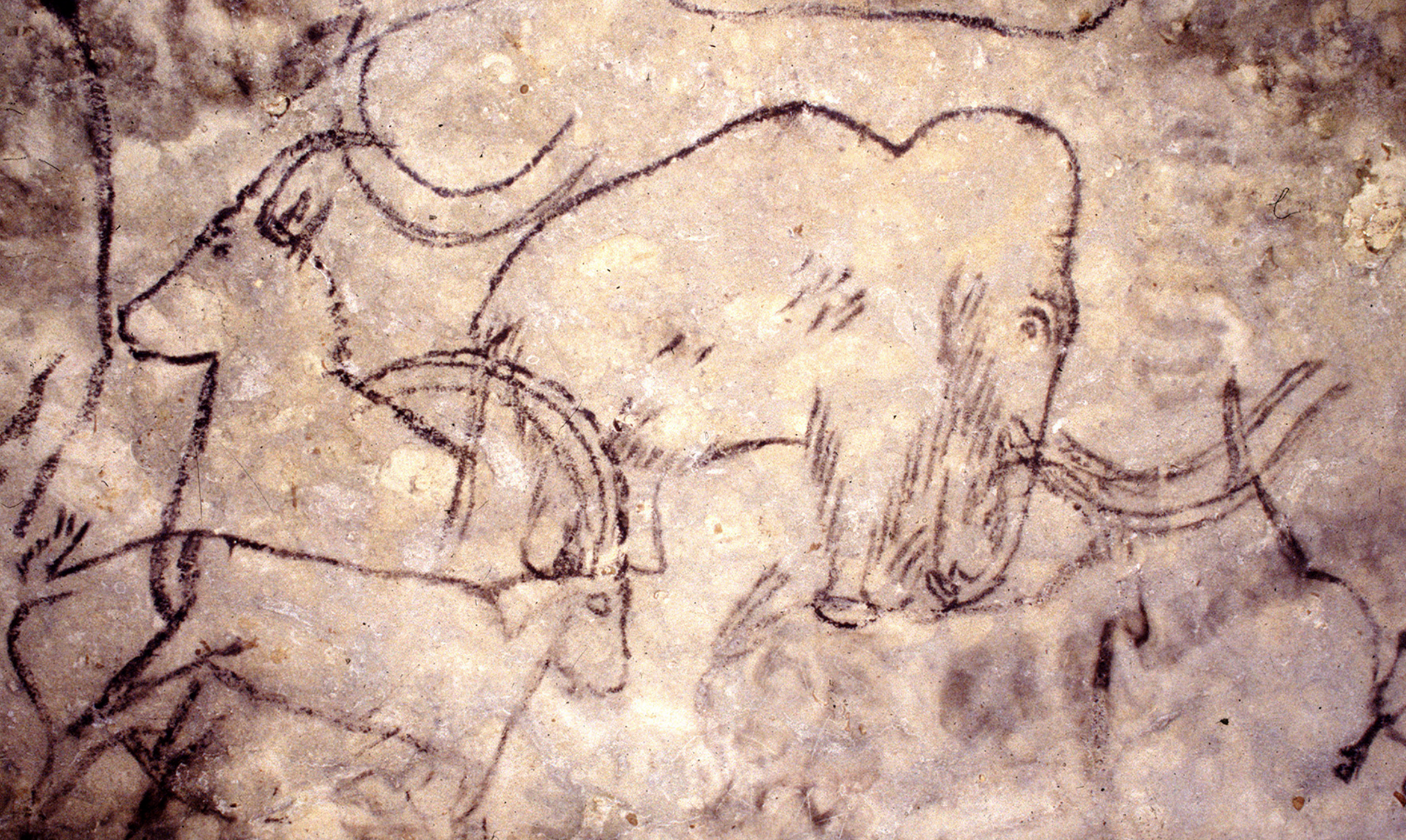
A dead woolly mammoth, to be exact.
(Certainly not what ChatGPT would suggest. All for the better, perhaps…)
So here we are, in the early Pleistocene.
The planet is much warmer and wet. All across African savannahs, herds of proboscideans (mammoth ancestors the size of small trucks) are crunching on shrubs and twigs.
Then, sadly, one of them is taken down by an ancient pathogen.
There it is, laying in the tall grass, waiting to be eaten by the first Homo habilis to come upon a dead mammoth.
Imagine a hairy human ancestor—let’s call him Charlie.
Out on his daily hunt, Charlie finds the brown mountain of meat. He doesn’t know it’s a miniature mammoth. What he does know is that his fifteen children are hungry, and animal meat very yummy.
Now, put yourself in the shoes (pardon, an anachronistic pun) of Charlie.
You’re a tiny human standing beside a huge mammoth cadaver, unsure what to do about it.
At first, you walk a few circles around the animal, contemplating not whether, but how, to break it apart. You shrug, then shiver at the thought of having to tear the whole thing to pieces and carry it home. It would take you several days, 100 kilometres back-and-forth. You’d rather leave it there, go home to a cave and bring it up again.
Soon, it will all come to seem like a distant bad dream.
The AI marketing mammoth
The mammoth is a fitting metaphor to describe how most marketers feel about AI.
It’s something supposedly good. But it’s also horribly big. Too big to make heads or tails of it.
And yet, you read another LinkedIn post and decide to check out Claude Code. First, you shrug. Then, you shiver. And because it’s a capitalist tech-driven world, you take out your stone dagger (trackpad) and cut (tap) into the pelt (signup button).
Yuck.
This was my first thought, too, when downloading Claude Desktop 6 weeks ago.
Then, I took some days to read my favourite marketing newsletters’ recent archives. When I returned to the real world, my eyes were sore and my head haloed with an artificial 3D ring.
The AI overwhelm is real
The key reason for marketers being stressed out over AI is that we look at it as one huge beast.
While, in fact, it’s an entire marketing team.
Just like a mammoth has legs, trunk, and belly, your marketing team is made up of several specialists.
But read five posts on your LinkedIn feed, and your mind reels. AI-led sales outreach, blog post generation, ASO optimisation, marketing asset design, etc. etc. etc. And you, feeling like I need to do it all NOW.
Because only a loser couldn’t implement 10 commandments by 10 diverse marketing experts in one week. Because only the bad marketers, soon to be replaced by AI, would fail to set up 100 new Claude Code skills and foundations and grow their company’s blog traffic + inbound leads 700% MoM in three months.
Right?
Ummm… There used to be LinkedIn posts about CMOs explaining to CEOs why this can’t be done.
I want to return to that pre-AI world.
But of course, I can’t.
To stay competitive as a marketer in 2026, you have to adopt AI to some extent.
Deconstructing the AI marketing mammoth
The most helpful thing for me, when returning to the marketing realm after 8 months of writing my sci-fi novel, was to deconstruct the AI machine.
It’s really not that different from joining a new company as marketing lead. Which is exactly what happened as I joined Roleo as their part-time founding CMO.
If you’re a full-stack marketing lead, you want to do (read: rescue) everything at once. There are obvious fires to put out. Meanwhile, you’re supposed to build a long-term marketing strategy, set up KPI tracking, launch paid advertising, and set up social media accounts. Not to speak of product launch support and website revamp.
It’s the same way with AI.
The abundance of AI use cases in marketing leads to decision fatigue and paralysis.
According to thousands of LinkedIn posts by the “experts” who use ChatGPT to scrape and rephrase their “expertise” into “comment for skills” posts, you should use AI for everything.
- Competitive research
- Daily & monthly planning
- Paid ads design & optimisation
- Content marketing & ASO
- Website & assets design
- Outbound sales outreach
- Social media growth
- Media outreach & PR stunts
The advanced gurus even suggest that you to build your AI second brain.
Sorry, Kieran. While I consider you one of the best marketing AI experts, I choose to keep my single brain and plan my own life.
The best way to overcome the sense of helplessness is to break the “AI in marketing” project into small, digestible pieces.
Marketers who stress about AI are looking at it as a single project. The solution is to break it apart and tackle it project by project.
Instead of saying: “I need an AI control centre for marketing.”
You could say: “I’d like to set up Claude Cowork to help me with competitor research and blog article writing.”
What changes is the project’s magnitude. By verbalising the exact outcome, you give yourself the agency to finish it.
- Identify 2-3 marketing AI use cases that would benefit you most (time savings or more quality output).
- Create a timeline for building out a Claude Cowork (foundation + skills) project for each.
- Take 3-4 weeks to build the Claude project, test it, teach it, and start benefitting from it.
Let the final point settle in.
Setting up Claude Cowork for high-quality output takes time. It can’t be copy-pasted from a LinkedIn post comment.
Which AI marketing use cases should you explore first?
It depends on your role in the company, and how advanced your marketing game already is.
Further, there are still some use cases where AI simply can’t replace human intelligence, creativity, and skills.
Like designing ad creatives or writing opinion essays. I didn’t use any AI to write this newsletter, only for spell-check later.
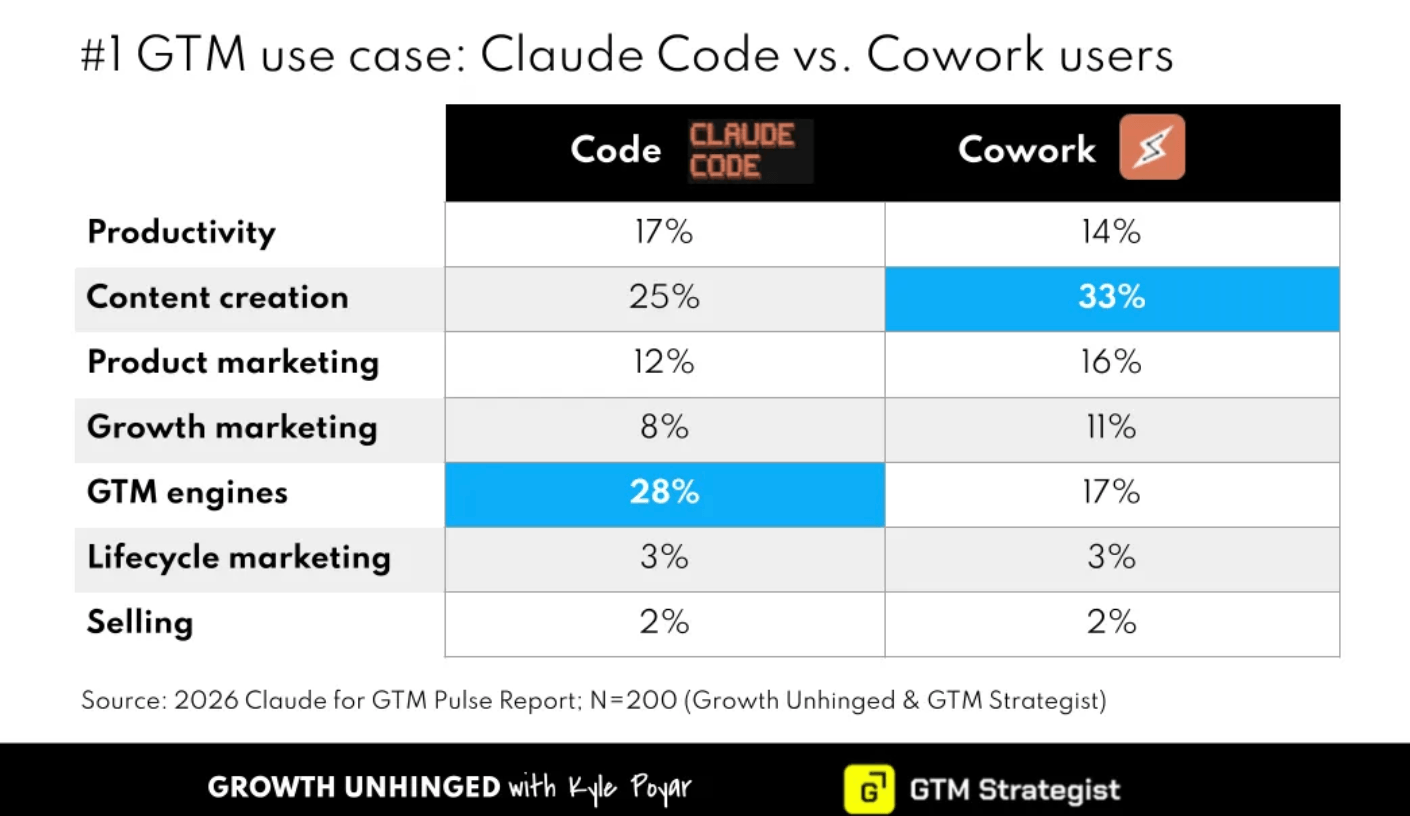
The image below shows how GTM teams use Claude Code. (GTM = product marketing, sales, growth, lead gen.)
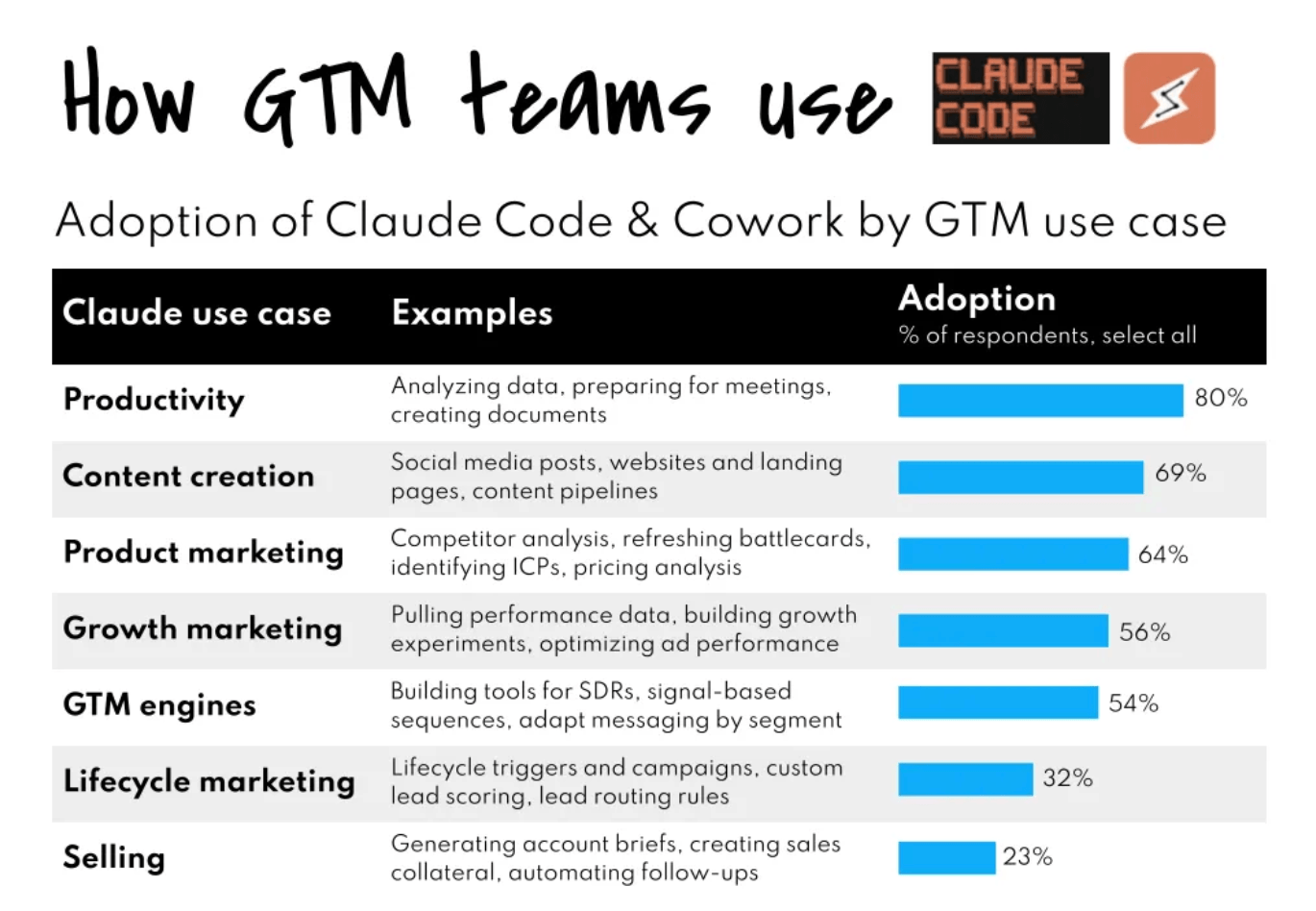
Take 30 seconds to consider where AI is most useful for you. (Remember: you are one person, not a team of twenty.)
As a full-stack marketer working with early-stage companies, my needs are quite different from the above chart. I don’t work with sales; I have to deliver immediate growth.
If you’re a mid-level marketer in a large team, specialised in 1-2 things, let me tell you this: Big companies hire automation experts to set up complex AI systems, including for marketing tasks. These people are paid €250k/year plus.
If you’re in a team of 5+ people, it should be your CMO, not you, who sets up Claude Cowork for the marketing team. And ensures it’s aligned with the rest of the company.
How I’ve been using Claude this far
Here are the primary tasks I’ve used Claude for over the past six weeks, and where I found it helpful vs. adding to the chaos.
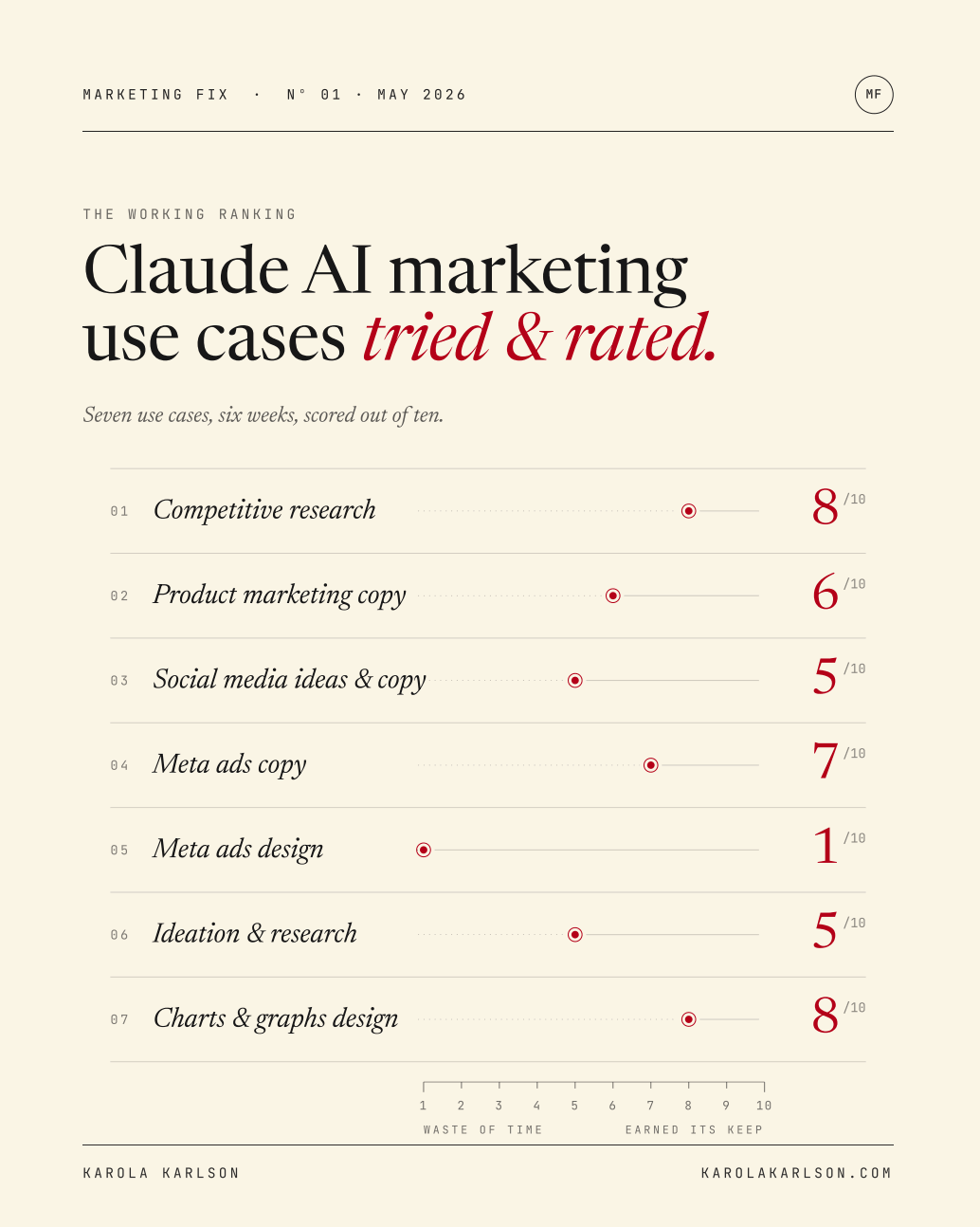
1. Competitive research: 8/10
Claude saved me 80% time by collecting all information in a spreadsheet. I still had to specify the competitors to check, collect relevant screenshots, review, analyse, and summarise.
2. Product marketing copy: 6/10
This use case only became useful after I set up a Claude Cowork project with detailed foundation files for brand voice, product features, competitors, and audience. It took me 3 working days and was totally worth it. I use it for drafting website and product launch copy, then rewrite everything in the end. It’s great for creating a logical structure and covering all important points. Also, for brainstorming 50 different headlines with a slightly different angle and wording.
3. Social media ideas & copy: 5/10
Horrible for original ideas. But once you set it up as Claude Cowork project, it can help with the first draft. Create brand voice guidelines, and provide detailed, original input. (No dropping in 50 LinkedIn posts by other people and asking the algos to copy them. In gastronomy, you can turn stale bread into delicious pudding; it doesn’t work in marketing.) In the end, I always rewrite the whole draft and use Claude for review.
4. Meta ads copy: 7/10
Actually pretty good, once you’ve set up Claude Cowork (see point 2).
5. Meta ads design: 1/10
A complete waste of time. Don’t believe anyone who tells you otherwise. Even the AI-design oriented tools like Figma, Adobe, Claude Design can’t properly render logos and align text. No shortcuts: learn Figma or hire someone.
6. Ideation & research: 5/10
I tried asking Claude for fun Latitude59 tech conference marketing stunts. It suggested some ok stuff. But ok is not good enough. In the end, it took me a 2h walk around East London to come up with the actual idea.
7. Charts & graphs design 8/10
I’m giving it a high rating because creating the visual below took me 10 minutes with Claude Design, from project setup to download. Caveat: I had to prepare a Figma file with brand assets and chart examples, which took me 2 hours. Plus you’ll need a CVI. Even so, huge time savings ahead.
While many pros recommend using Claude Code, you can do most marketing work with Claude Cowork. It’s got chat-based interface instead of Terminal.
“Just three months after launch, Cowork (32%) has already surpassed Claude Code (31%) as the primary Claude product among GTM operators we surveyed,” Maja Voje and Kyle Poyar reported in April 2026.
The survey of 200 GTM specialists confirmed that many prefer Cowork, especially for content creation, product and growth marketing.
Where I wouldn’t use AI as a marketer (and a human being)
Roughly 75% of the AI use cases the LinkedIn experts hype, I’d never use myself.
They either take more time than they save, or produce low-quality results.
1. Reporting & ad account optimisation: I prefer to do it manually every week, and process the information with my own brain.
2. Website & ad design: It’s just not working yet. I made some graphics with Claude Design for this newsletter. Not sure I ended up saving time.
Meanwhile, I was working on rebranding Marketing Fix this week, and did everything manually on Figma. Claude was helpful for researching premium typefaces. I then browsed are.na for hours to research colour swatches, editorial style, and typography. Finally, I designed everything manually on Figma.
3. Social media & newsletter writing: I’m a writer, after all. And I find something deeply degrading about serving other human beings “content” written by a machine. Just as I wouldn’t serve my friends Snickers and McDonald’s fries.
4. Human-to-human communication: I understand why sales teams contacting 100s of people each week automate the process. You can do it with Apollo, Clay, etc. But as I only send 5-10 work-related texts per week, I prefer to write them myself.
The stuff you don’t need AT ALL
I’ll end my rant-slash-therapy-session by repeating my unswayable belief:
There are many overcomplicated marketing AI use cases nobody actually needs.
Here’s an example of the type of LinkedIn post we’d all be better off without.
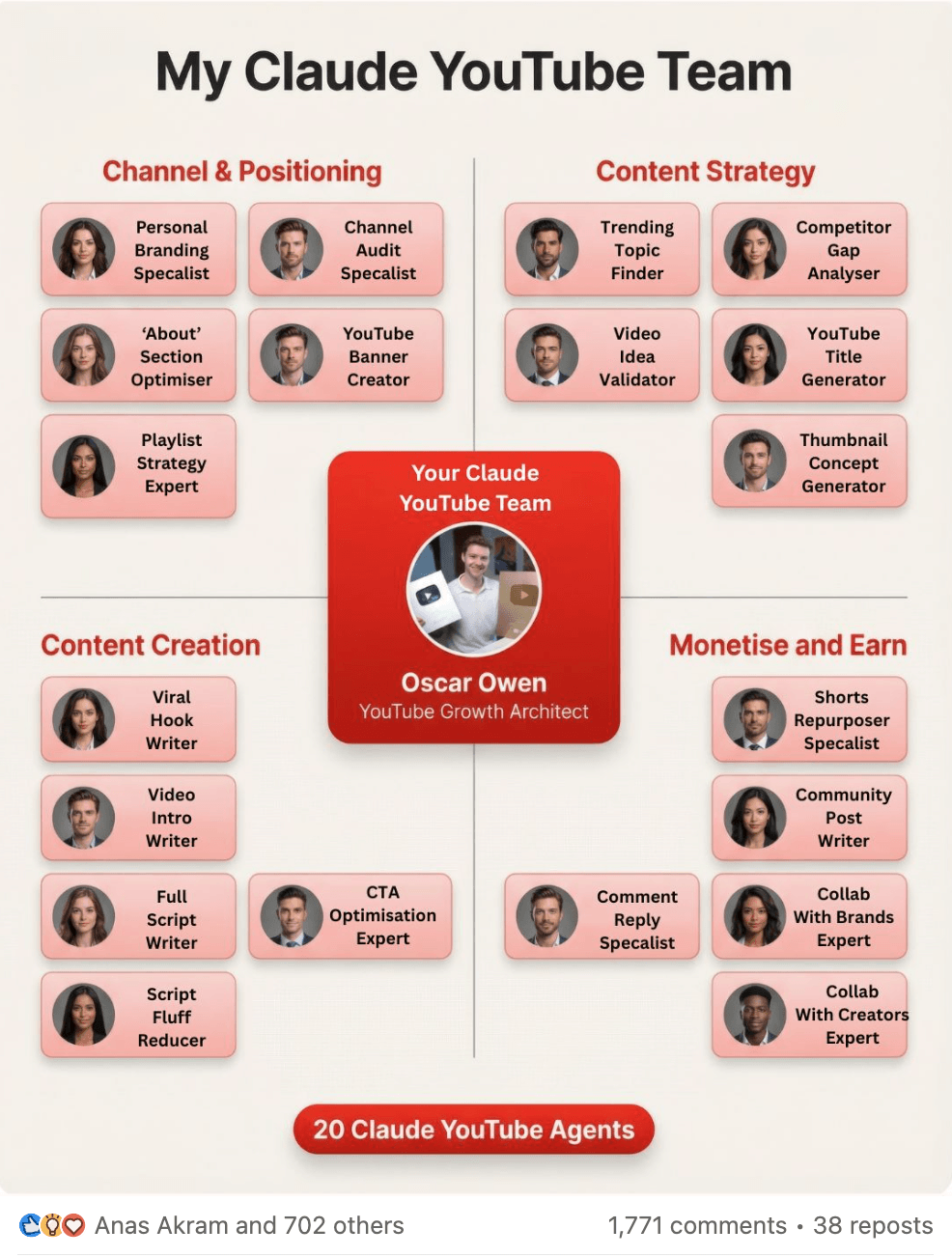
What it does is expand a single Claude Cowork use case into 20 “agents.”
Most of these are useless to your decision-making. They only add noise and extra work.
And extra anxiety.
Instead of creating 20 AI agents, you could simply set up a Claude Cowork project with a solid foundation and 5-6 skills for ideation and content creation. It writes all the assets in one task, instead of being uselessly broken down into 10 different details. Plus you might set up some bot for reaching out to collaborators and answering comments, if the volumes are high.
The branding, reporting, and designs you still have to do manually. That is, if you want them to be any good.
How to get started?
You probably already have.
It’s me who returned to marketing after a hiatus, and had to begin learning from scratch.
But in case you want a reset, or are still in the overwhelm phase, I recommend that you start following 4-5 people who are real experts on the subject.
Here are my go-to marketing newsletters on AI:
- Maja Voje: GTM Strategist
- Kieran Flanagan: Marketing AI in Action
- Ruben Hassid: How to AI
I will also be sharing detailed breakdowns of how I use AI for marketing tasks in Marketing Fix blog and Substack.
Help to keep me motivated by inviting other marketers and founders. Share Marketing Fix.
Coding skills vs. taste
There’s a new discourse about taste being the AI era’s most valuable skill.
I agree.
When anyone can generate marketing text and visuals in a single prompt, curation and authentic ideas become key differentiations.
As a marketer, you should be well aware that as long as your product is alright, original branding is what makes it stand out.
What can’t be prompted is something that didn’t exist before you created it.
“Writing, good writing, will therefore always be a place where something unknown, something which didn’t exist before, is given existence,” the Nobel Prize-winning Norwegian author Jon Fosse wrote.
Instead of sweating about learning to code, become genuinely curious about art, dance, books, film—whatever you fancy.
Spend time away from your screen, in the real world. Because the people you’re marketing to, god bless, are still not running on AI brains.
Here’s a list of the best books I read a few years ago. Perhaps you’ll find something to get you started.
Further reading recommendations: